Showing posts with label politics. Show all posts

12 August 2013

David Hawkes in the TLS and Chomsky (eclectics and science)

On FaceBook a mate of mine linked to an article by David Hawkes in the TLS about Noam Chomsky: How Noam Chomsky's world works

I made the following comment:

This is a weasel article full of half-truths and very slippery deductions. Chomsky himself is to blame (as always  ) for not going the whole hog and following reason along the path it beat after Kant and the French revolution using Hegel and especially Marx. But Hawkes is either disingenuous or blind to his own analytical shortcomings here (pot kettle black as Chomsky might be tempted to say). 
In the first place, rooting language in a biological capability doesn't turn people into objects or language into a non-social phenomenon. We use our brains to orient ourselves in the world as subject (or let's say a self-orienting object among non-self-orienting objects) and language is one of our special human faculties for doing this. Science and logic and so on have nothing to do with capitalism as such, they are formalized and institutionalized human capacities and activities that have developed in various kinds of societies to improve our self-orientation. Capitalism as a form of society drove this development much further than any previous society. Now capitalism is incapable of taking things any further and socialism will either take over the baton or humanity will collapse into an unimaginable state of barbarism.
Hawkes gestures abstractly at Marxism in what he writes, but makes damn sure not to give chapter or verse or make any concrete observations.
Chomsky is empirical and rational, and driven by scientific curiosity. Once something appears to him to be empirically and rationally validated he takes it as a basis for a next step. In this he is ruthlessly logical. The US government lies and goes to war using violence and atrocities for the benefit of big capital. The US media establishment supports it to the hilt. So get used to it. Structuralist and behaviourist linguistics only scratched the surface of human language and drew all kinds of misguided conclusions about it. Chomsky blew them out of the water by taking structuralist method as far as it would go and transcending it, as any good philosopher and/or scientist would. As Syntactic Structures brilliantly demonstrated in 1957, and I was privileged to discover in 1965.

Anyhow, more of a conundrum in Chomsky is the modesty of his approach. What is revolutionary is the ruthlessness with which he holds to scientific principles and the insistence with which he asserts his findings and pursues their logic, not the content of his findings as such. The problem for reactionaries and trimmers and eclectics (like Hawkes) is that they don't understand the depth of his certainty and conviction once his principled conditions for reasonable proof are met. The trimmers are swept around like dust by winds and tides (Dante has them blowing about helplessly on the banks of the Styx, despised even by Charon and refused even the basic courtesy of admission to Hell - they have done nothing worthy of eternal residence anywhere  ). Like all good scientists, Chomsky gives us an Archimedian "pou sto" (somewhere to stand) - a stable fulcrum that we can use our levers with to move the earth. One that winds and tides swirl around, not one swirled around by winds and tides.

26 November 2012

Revolutionary priorities - human rights and combating bureaucracy?


On my translators' discussion list, PF replied to me:

You use the word red herring a little too liberally. If the protection
of human and individual rights and preventing the abuse of power by a
ruling party/bureaucracy are not to be the _first_ priorities in a
socialist revolution, you can revolute without me.


And I responded:

There's a place for people who have priorities besides state power in revolutions. Obviously. And obviously everybody chooses how to get involved - it can be purely political - you can be for the new regime or against it, or socio-economic too - for the new state or against it. And you can choose to keep your head down and your fingers crossed, as Stalin did during October when he was skulking in the editorial offices of Pravda preaching conciliation with the Provisional Government. And you can scoot off to your dacha and sit it out. 

Revolutions happen, almost regardless of our priorities and wishes. You can't prioritize or wish a revolution into being. And you can't wish away the violence involved. As a worker you'd be mad to be a pacifist while the counter-revolutionary white guards are shooting at you. 

The organization, vitality, democratic health and programmatic clarity of the forces involved are what determines the fate of issues like human rights during a period of revolutionary upheaval. In general, revolutionary armies have codes of conduct requiring humane treatment of civilians and enemy combatants -  often on pain of death for violations - while counter-revolutionary armies behave despicably. Pissing on enemy corpses, mocking enemy cultural values, raping and stealing, etc. Chiang Kai Shek and the Kuo Min Tang reactionaries are perfect examples of this.

When it comes to post-conflict social life the same goes. If there is a low level of organizational vitality, democracy and programmatic clarity in the leading political forces, you're in for trouble. Sometimes regardless of your priorities and wishes. It is ridiculous and unhistorical to foist the blame for the degeneration of the Bolshevik Party in power on Lenin and Trotsky. Neither creating an intelligence service nor putting down a serious mutiny are exceptionable matters in a situation of extreme social tension, let alone a war. When you have a series of deliberate constitutional changes aimed at reducing broad popular participation and increasing the power of a bureaucracy and executive working in cahoots, then you have an exceptional threat to popular rights and the healthy exercise of power. In the final year of Lenin's life it is very clear from his writings that he regarded the bureaucratic cancer creeping over the government and party-political and social life as a very high priority. In his "testament" he warns explicitly of Stalin's flaws.

Creating and maintaining a healthy political regime in a political party isn't easy. It doesn't get any easier if people with healthy instincts turn their backs on politics because it's hot in the kitchen and pots go flying. Parties (despite what Tomás claims) are where politics are forged. The heat and steel come from the masses and their interests, but the weapons (programme and strategic plan) and leaders come from the parties. 

Like I said, revolutions happen. We can choose to revolute along with them, or against them, or stand and watch. They are mass events. Mass mobilizations. You don't have to go around knocking on doors to get people out to make a revolution. That's the whole character of them - they are social eruptions. If I have a programme and leadership to offer for a revolution, then the masses in their assemblies will decide whether to take them or not. As happened throughout 1917 in Russia during the revolutionary upheaval between February and November, when the Soviets were massively democratic assemblies of workers, peasants and others who thrashed over a huge number of political and organizational matters. The victory of the Bolshevik programme and party was in no sense a manoeuvre or a coup. The Soviets were the great centres of mass decision-making where the weapons and leaders of the revolution were selected in open competition. The Mensheviks screwed up and were rejected (as was Stalin's conciliatory line towards them).

Plenty of Mensheviks ran away from the revolution when they lost favour. But it was no great hardship for many of their leaders, they just exchanged an editorial office in Moscow for one in New York and got lionized by the imperialists (Kerensky, for instance). 

There is ample prima facie proof of the popularity of the Bolshevik leadership of the revolution with the Russian people in the mere fact that over a hundred million Russians followed them in war and faced extreme hardship for three years to chase out and keep out Russian (Ukrainian etc) reactionaries and imperialist invaders. There were never enough Bolshevik commissars to whip the peasants into doing this by brute force - the Tsarist knout was a thing of the past. The peasants and peasant-workers in the army, for Christ sake, had thrown down their weapons and deserted from the Tsar's army only the previous year! And yet they took up arms again and followed Trotsky's strategic guidance and fought successfully!

Please, Paul, try and get some perspective into this period of Russian history. If the not-even-socialist half-measures of Allende and the popular upsurge of his day in power are inspiring, before Kissinger and Pinochet smashed them, then surely the real social and economic changes that took place between 1917 and 1920 in Russia are even more inspiring, especially since the many Kissingers and Pinochets of the time were soundly thrashed and sent home whimpering with their tails between their legs.

12 March 2012

China and capitalist restoration

In a discussion on FaceBook (11 March 2012) Gerry Downing answers MT and takes the opportunity to  justify the idea that capitalism has been restored in China.
Gerald Downing FaceBook

I don't know why you think I think that China is a deformed workers state but you are wrong. In my view the date of transition was 1992, although that is arguable (Workers Power put it at about the same time). Here is what I think:Let us list the features of the Chinese economy and state to see which it is;1. The “iron rice bowl” is basically gone. Mao’s welfare state has been abolished apart from in a few places. The Gini Coefficient shows a sharply rising graph of income and wealth inequality in China since the early 1980s as in India, not yet as high as Brazil, Mexico and South Africa but getting there. 2. There is a thriving capitalist sector with its own class differentiated bourgeoisie and working class. China now has more millionaires than the UK, Germany or Japan, although at 450,000 it is still a long way behind the U.S. even though that fell by 2.5 million to 6.7 million in 2008. All deformed and degenerated workers’ states expropriated their capitalists and prevented that class arising anew. 3. There is a Stock Exchange and capitalist banks, although, a la Bismarck, Stolypin and Keynes, they are state controlled (unlike in Britain under Blair and Brown) to ensure the better development of capitalism. All deformed and degenerated workers’ states had/have no stock exchanges. This is not neo-liberal capitalism but it is capitalism nevertheless.4. The monopoly of foreign trade is gone but the state still retains strategic control over trade as good capitalist planners. All deformed and degenerated workers’ states had/have a state monopoly of foreign trade.5. They are developing as an imperialist power; their investments in Africa, South America and Sri Lanka, for example, are for purely commercial and strategic/military purposes. This is totally unlike the practice of the USSR where support and investment was to strengthen their hand and give them more pawns in the chess game of achieving peaceful cooperation and compromise with the world Imperialism. The USSR was prepared to sponsor, ideologically and materially, armed opposition to imperialism to this end, China arms its clients but has no ideological opposition to imperialism, however distorted, to offer. However China still retains strong elements of a semi-colonial state in its far-flung backward regions, which are prey to US/CIA interventions to begin the breakup of a developing rival. It is still a long way from a fully fledged imperialist power and history never proceeds in a straight line without wars and revolutions so its uninterrupted development is far from certain.Comrades, when we see a bird that walks like a duck and swims like a duck and quacks like a duck, we call that bird a duck. James Robertson had pragmatically seen the significance of the long swim of the capitalists from Cuba to Miami by 1966 but the International Committee of Gerry Healy and Pierre Lambert refused to look at what had happened there after 1959. In his play Galileo Bertolt Brecht’s Galileo invites the leading scholars of Florence to peer into his telescope for the ultimate proof that Aristotle was wrong; but the men refused to look, instead making evasive, dogmatic speeches about why the telescope could not possibly show any such thing. A little more pragmatism and common sense would now assist comrades, before we progress to the more complex world of the Marxist dialectic. China is capitalist, look; it waddles and paddles and quacks, it’s a duck!.


I responded: 


Sorry, Gerry, I think your duck might turn out to be a swan - even though it's exceedingly ugly as a duckling ;-)
Your version of the history of the capitalist mode of production in the era of transition to socialism is impressionist because it ignores all the important historical questions. 
Most importantly it ignores the question of how modes of production develop and transform - from slave-ownership to feudal to capitalist etc. Despite occasional hiccups they don't head back. It's not straightforward, but it's irreversible. If the new mode of production breaks down, you get chaos and catastrophe - in our day formulated as socialism or barbarism.
So if imperialism is the ultimate stage of capitalism (ie can develop no further scientifically speaking, but just decay or metamorphose into something new and non-capitalist) and is essentially capitalism pregnant with socialism, we must ask what the direction of history is and why capitalism can so easily return to a country where its foundations were destroyed. Against the tide. This tide - clearly seen by Marx in the 1860s, where he states (in Capital III) that capitalism is socialized through and through in every respect except ownership and the direct consequences of ownership), and fully accepted by Lenin - is important for understanding the history of the 20th century. Especially the Soviet Union and its character.
First of all, it's the only possible explanation for the survival of revolutionary Russia and the Soviet Union for seven decades. Trotsky recognizes this in the Revolution Betrayed where he attacks impressionist notions that the Soviet Union was no longer a workers state in 1936. The political distortions in the Stalinist USSR were at least as great as the economic distortions in China today, if not greater - Trotsky didn't hesitate to draw direct parallels between the Stalinist regime and the Nazi regime in Germany. He characterized it as counter-revolutionary. But the foundations of the USSR were different. The capitalist "integument" had "burst asunder", and social economic productive forces were no longer constrained by private appropriation. The results of the newly unleashed productive forces were skimmed off by the bureaucrats, of course, but this isn't the same.
Right, so despite a counter-revolutionary regime that banned all political opposition and critical Marxist thinking, crushed oppositional organizations and individuals, didn't understand Marxist economics, and spread lies and confusion about socialism, the new workers state, crippled, weak and impoverished, survived for seven decades and put the imperialist world to shame on many fronts.
When the bureaucratic regime finally sold out to imperialism we got to see real economic counter-revolution in the mode of production sense. First and only time. No lessons have been drawn from this in relation to China. Impressionism talks as if real economic counter-revolution has taken place there too. This is making a nonsense of the category of counter-revolution. Both poltical and economic. Counter-revolution on this scale is spectacular. 1991 in Russia, however well prepared it was politically, and however eagerly and non-militarily embraced it was by imperialism, was not a reformist transition, an undramatic gliding over to capitalist ownership and management.
The urban and rural workers - trampled and despised under Stalinism - were stripped of what little they had left. But this little was HUGE - it was the fundamentally different relationship between a worker and the forces of production in a non-capitalist state. Every speck of inequality and meanness and brutalization in the USSR had arisen AGAINST the nature of a workers state, even a backward and isolated one in a world dominated by imperialism. Superficial analyses (eg the State Capitalist view) missed this aspect of the USSR completely. 
In China, however well prepared the political and some of the economic conditions might be, we have seen nothing approaching the devastation and barbarity of post-restoration Russia. The political chaos. The human destruction. Reversing a mode of production from non-capitalist to capitalist is non-trivial. It means (historically speaking) ramming a big bouncing baby back into a womb that was already too small before it was born. In Russia the only way the restoration has survived is by reshaping the womb, so to speak. The social scale of the forces of production could only be handled by the state taking over the role of capitalist - leading to a real state capitalism run by loyal oligarchs and powerful politicians. Foreign imperialism is nowhere. 
No one has bothered to envisage what might actually happen in China following a real restoration. We have lazily watched capitalist techniques being introduced and just nodded sagely saying: "look - restoration - goodness me..." This has also led to idiotic reinterpretations of "pre-restoration" such as "Mao's welfare state".
In the Revolution Betrayed Trotsky castigated those who treated the bureaucracy as one featureless mass. He pointed out that the class struggle doesn't vanish because its surface expression is suppressed. But the same error is being made in relation to China. And this is the second big problem of the China is Capitalist view. The Chinese bureaucracy is larger and more powerful and far more stable than the Soviet bureaucracy ever was, but it is just as riven by economic, social and political differences - the material interests of the lower, middle and upper bureaucracies are not the same, and often they are in complete contradiction. Lower bureaucrats would stand to lose everything in a restoration. Middle bureaucrats (as always) feel more secure with the status quo. Upper bureaucrats (the equivalent of the Soviet nomenclatura) would probably prefer restoration. Now - and this is BIG - for Marxists a state is an apparatus mobilizing violent force to maintain and defend a particular mode of production. The army, militias, and the elements making them up. Not just leaders but rank and file. Not just general staff but higher and lower officer castes, and the foot soldiers. This organized violence is inextricably bound up with the political and economic management of the state. 
So where does the army stand in relation to restoration? Well, bugger me, how should I know, is the answer, to judge by the total lack of inquiry into the question. 
In short, it's reasonable to assume that there are very powerful forces in China working in both directions - for restoration and against it. Much stronger and more contradictory than they were even in the Soviet Union, as China is a larger and more powerful nation.
Further, just as the USSR prospered (in spite of everything) during the 30s while imperialism was on its knees, China has been prospering during the loooong drawn out death rattling of the great capitalist crisis following the post-war reconstruction (etc) boom. Since say 1980 (when Thatcher and Reagan initiated a desperate reactionary assault on the core imperialist working class) China has been doing very well thank you.
Now, if I were a Chinese bureaucrat of any rank (particularly perhaps a top bureaucrat) I would be asking myself this question: "if imperialism is making such an intolerable mess of things, getting bogged down in expensive unwinnable wars, rotting away socially, lurching from one deep crisis to the next even deeper crisis... and I'm doing just fine with things the way they are here, getting kickbacks from my industrial and financial cronies... and my cronies are doing just fine being looked after by me... Why the fuck would I ever be stupid enough to give everything up and join a losing side? Why should I go aboard their sinking ship?? They are now coming to me with a begging bowl. Asking for bail-outs and handouts, begging for mercy. Nope, I'll carry on as I am for a bit, I think. So, as far as full frontal restoration goes, thanks, but no thanks."
These questions I raise are all fundamental. They can't be answered with trade figures or organizational charts. Economy is Political economy, not company economics, and the big political questions just aren't being asked.
If we hold with Trotsky, then we should move beyond the Revolution Betrayed (1936) to the Transitional Programme (1938), a much more general document assimilating the lessons worked out in the Revolution Betrayed and all of Trotsky's and the class's previous Bolshevik-Leninist experience.
The most important single sentence in the TP is the very first: "The world political situation as a whole is chiefly characterized by a historical crisis of the leadership of the proletariat."
We need to work out what this means ACTIVELY in relation to problems of capitalist restoration and the fate of Russia and China. It's not enough to passively sit around and bemoan "restoration" and counter-revolution without even considering this aspect of the matter. Because what is happening in Russia and China, obviously, is an expression of the class struggle today in a period of extreme imperialist putrefaction. If "restoration" can be brought about at the stroke of a pen, at the whim of some highly placed bureaucrats in Beijing, and does not depend on a social cataclysm involving a direct confrontation between the working class and the bourgeoisie, then we might as well go into "politics" and fight for a place by the trough in Brussels or Washington. There was no bourgeoisie in the Soviet Union when restoration occurred (which is one reason why it took so long to materialize), so the confrontation was far from straightforward and extremely mediated. There is no real bourgeoisie in China (no state power, no control of commanding heights or army etc etc) so there will be no straightforward confrontation there. 
What we have to do is to work out what social (ie class forces) will be involved in the decisive confrontation, how the bourgeois element will be mediated in China, and in what way we can bring an end to historical crisis of the leadership of the proletariat.
We can't do this by handing our enemies a walkover and letting them win by default. "Oh shit, capitalism just restored itself in China. Well, ain't that a shame. Still, it'll be our turn soon..."
I think if a political Galileo were to ask today's "scholars of Florence" to look into his telescope, the thing they would shrink from observing would be "capitalism pregnant with socialism", and a Chinese workers state whose social and economic fate is by no means decided yet.
This very ugly duckling might make quacking noises, but if we use Galileo's microscope (well, today's equivalent :-) we will see that the DNA is that of a swan.

4 January 2012

Judging China using western economic criteria


China is different - as I argue below in a FaceBook discussion


www.telegraph.co.uk
China's credit bubble has finally popped. The property market is swinging wildly from boom to bust, the cautionary exhibit of a BRIC's dream that is at last coming down to earth with a thud.


December 15, 2011 at 10:53am


Choppa Morph China can't be judged using western economic criteria. In the first place western economic theory is bollocks - they can't understand their own economy (nation-based imperialism and world capitalism) for starters - just look at the mess in the US and Europe that they are helpless before and can't give any coherent explanation for. In the second place - and I assert this with tremendous confidence - China is not fundamentally capitalist. It's still a deformed workers state. The Stalinist USSR degenerated monstrously in the political field, less in the economic. China is monstrously deformed economically, less in the political field (Trotsky made direct comparisons with fascism, and was right - this can't be done with China, however much we detest its repression.
So it's a proto-socialist state that is mismanaging this appallingly - cos it doesn't understand or want to understand Marx's economic theory. But as such it isn't subject to capitalist laws of investment or credit. Above all it doesn't need to subject itself to western-style demands for short and medium term returns on infrastructural/large-scale productive investment. The USSR outperformed all the imperialists in terms of pave of development throughout the 30s. (Good stuff on this in The Revolution Betrayed by Trotsky, of course.)
Mistakes will be made and losses and lurches - how not?! - but they will have nothing   the effect such things have in the imperialist world.
If China fucks up it will be because of political action by the top bureaucracy changing horses and selling out to imperialism - as in the USSR. I don't think the conditions for this are present now, for lots of reasons. The most obvious one at the moment is that imperialism is an visibly stinking and bubbling economic cesspool and who would voluntarily jump into that? The top bureaucrats can do very well thank you expanding their present positions as is.
December 15, 2011 at 10:53am ·   · Description: https://s-static.ak.facebook.com/rsrc.php/v1/yw/r/drP8vlvSl_8.gif 1

Kriya Zur I don't think real estate and "property market" constitutes fixed capital investments... That is allowed greater flexibility in China than fixed Capital investments . Additionally, since land below the structure is all nationalized in China the real estate market appears very different than what it does in India which also means that the property market "swindling" in China would have much lesser effect
December 15, 2011 at 11:58am · 

R H S ‎> since land below the structure is all nationalized in China...
Just   in Australia....
December 15, 2011 at 12:06pm · 

Kriya Zur Eminent domain ?
December 15, 2011 at 12:07pm · 

Kriya Zur ‎@Robert : What acc. to you would be non-capitalist ownership of land then ?
December 15, 2011 at 12:24pm · 

R H S Not sure if state ownership is necessarily non-capitalist. In Australia you only can rent land, not buy. This gives income to the state and a certain 'grip' on real estate, but the overall effect does not seem to be very different from owning land and pay taxes over it perceived value.
December 15, 2011 at 12:45pm · 

Kriya Zur That still doesn't answer my question. Presuming that government ownership of land is merely another form of capitalism where private property technically doesn't exist, what then IS non-capitalist property ? Also there's a contradiction and vagueness in your comment you say that the government has a "grip" over real estate but then say that "the overall effects don't seem to be very different from owning land and pay taxes over it perceived value" . The contradiction is that there is no ownership of land by private persons and all land is owned by the government so how is the tenant able to SELL the land which he does not own ?
December 15, 2011 at 12:57pm · 

R H S The very word property is a capitalist concept, so I'm at a loss what you're looking for.
When the stae owns all land, the possesor of a certain piece of land does not sell, it, but just passes the lease contract to somebody else. He can charge whatever he  s, providing he finds a candidate. I assume however that 'the state' (/municipality/whatever) has a veto. Not very different from the western concept where the state may veto or regulate the *use* of any land, whoever the owner.
December 15, 2011 at 1:04pm · 

O C China is not so strong than we believe. Not all people live well. There is a big difference between towns and country. The last people live   Mao´s times.
December 15, 2011 at 3:11pm · 

Adhiraj Bose ‎@Robert : There cannot not be a Socialist property that is an impossibility. Every social form be it Capitalist or Socialist is based on how property is used and organized. In fact the very difference between systems in how property is organized between one and the other. Capitalism differs from Feudalism in that it can be freely transferred and owned by private persons excersizing their free will based on their wealth rather than their birth as it was with feudal nobility. Under Socialism the private aspect of ownership logically would stand abolished in favor of Social ownership. In transition this necessarily means the state having complete ownership of property. More important than that of course ... is who controls the state i.e. which class controls the state.
December 15, 2011 at 5:09pm · 

R H S Evidently we live a world apart, both geographically and historically. When we had a feudal system, in what we call the Middle Ages, a big and wealthy middle class existed and they transferred property between them all the time.
"Social ownership" as in 'Everything belongs to all of us and nobody is responsable'? I wish you a great future.
The question 'Which class controls the state' reveals where you're coming from; in a functional democracy there are no classes and the state is controilled by whover won the last elections.
BTW My son H S lived in Pune the last half year!
December 15, 2011 at 7:39pm · 

Kriya Zur ‎@Robert : Read up some English history then :-) and see how Common law came into existence. On the point of 'responsibility' have you heard of such things as COOPERATIVES ! :-) *( P.S : Amul cooperative is a $3bn enterprise :) )
December 16, 2011 at 9:35am ·  


24 March 2007

Renewable energy about to boom - forces of production asserting their primacy

A couple of snippets in today's news that remove any doubts (my emphasis).

DENVER -- State lawmakers laid out an ambitious plan this week to fund renewable energy development through a new Clean Energy Development Authority with the power to issue bonds.
"We'd love to see this become the Silicon Valley of renewable energy,"Colorado needs to move fast if it wants to be a player.[...]
Sen. Ken Kester, R-Las Animas, said the plan could provide virtually unlimited funds for renewable energy projects. The tax-free bonds could be backed by the state if the Legislature and voters approve. The authority could also issue bonds without state backing.
"Some of those transmission lines cost $1 million a mile," Kester said.
Kester said Texas, Wyoming and New Mexico are already ahead of Colorado in the race to build a new energy economy.
James Tarpey, a member of the Wyoming Infrastructure Authority Board, said his board has the authority to fund projects that cost $1 billion or more.[...]
Gardner said there would be no limit on the amount of bonds the authority could issue.
"The capital infusion as a result of this bill is unlimited," he said.
Sen. Chris Romer, D-Denver, said Colorado has the renewable energy assets and can't afford to squander them.
"We are clearly the Saudi Arabia of wind, solar and carbon assets," he said.[...]

Colorado lays out ambitious energy plan
and:
BANGALORE: Tata BP Solar, a Bangalore-based 51:49 JV of BP Solar and Tata Power is looking at opportunities in other alternative energy sources like wind, hydrogen, natural gas (low carbon) and hydro apart from their solar energy business. It also plans to invest $300 million over a 300mw cell manufacturing plant to be launched by 2010 in Bangalore. This will be the largest manufacturing plant for BP Solar, globally. BP Solar has manufacturing capacities in Spain, US, Australia and China.
BP Solar is a part of BP Alternative Energy, which over the next 10 years aims to invest $8 billion globally in solar, wind, hydrogen and natural gas power technology. BP’s investments in India include Castrol India and Tata BP Solar. Speaking to ET, Lee Edwards, president & CEO, BP Solar said,
“The JV with Tata Power has huge potential, therefore, we could look at more opportunities in other alternative energy sources. Tata BP Solar has been witnessing around 40% growth in India over the last two years.” The company has recorded revenue of Rs 650 crore this fiscal. Currently, 60% of the solar cell produced in Bangalore is exported to Europe.
Tata BP Solar has added 36mw solar photovoltaic production line capacity with an investment of $22 million to the existing 16 mw taking the total cell manufacturing capacity to 52 mw per annum. The board has also approved of $100 million investment for the next phase of expansion, which will see an additional 128 mw of cell manufacturing capacity to be added during 2007-08, taking the total capacity to 180 mw. This is a part of the planned 300 mw cell manufacturing plant.

The big deal here is two-fold.

First US politicians talking about the new energy economy in the terms of a race: "Kester said Texas, Wyoming and New Mexico are already ahead of Colorado in the race to build a new energy economy." And the talk of "unlimited funds", "virtually unlimited capital infusions", "the Silicion Valley of renewable energy", "move fast if it wants to become a player" - the competitive spirit is being cheer-leaded here with great vigour. "You're behind, get moving!" and the pom-poms and short skirts of capital are undulating and shimmying, arousing the sluggards to perform.

Texas and California have been jousting for months now about who's leading the wind generation league. So now solar is coming in too, and Colorado is piling into the ruck. As is Arizona in other news. This indicates that not only will all pessimistic forecasts for the growth of renewable energy in the next decade or so be trampled in the rush and forgotten, but that big oil and nuclear will have to shift their active capital and effort fast to stay in the game.

And blow me down if the Indian news doesn't underline this very thing. Everyone knows BP is big oil, but TATA INDUSTRIES is not at all well known. It is basically Manufacturing India, Inc. So with Big Oil and India Inc starting to move (and the figures aren't quite peanuts), the game is going to be sweatier for the US would-be players to thrust their way into than they might imagine.

Add to these very empirical signs the new emphasis on energy conservation in heating and lighting, moves to bio-fuels (ethanol, bio-diesel, wood pellets), and the still a bit speculative and research-based work on geo-thermal (heat pumps), tidal and wave energy, not to mention the revamped ideas about harvesting solar energy from space, and there's something spectacular under way.

Simply put, even under the warped and repressive social relations of capitalism (with its undemocratic and conflict-ridden monopoly ownership of resources, production facilities and what we might call Big Knowledge - the kind that gets patented and copyrighted out of the public domain and hidden away in corporate R&D or narrow specialist publications) the forces of production (technology and the demands of technology in relation to human social needs at this level of technological development) are forcing us into the realm of socialist (non-capitalist, cooperative, internationally coordinated) development.

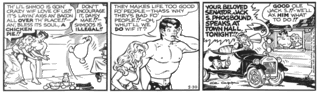
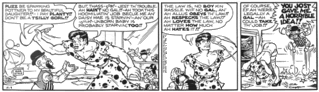
Like a giant modern Prometheus in its boyhood growing into adolescence, human productive potential is right now being forced to contain its bulging body in the rigid childhood suit of armour provided for it by its wicked capitalist guardian. The spectacle is ridiculous - Li'l Abneresque (Li'l Abner) - shmoos are popping up everywhere ("shmoos is bad fo people" ), and yet "we" have to exterminate them for the "good of society" ("ah loves the law").

Marx wrote well over a century ago that finance capital (as a fully developed bank and credit system):

The banking system, so far as its formal organization and centralization is concerned, is the most artificial and most developed product turned out by the capitalist mode of production, a fact already expressed in 1697 in Some Thoughts of the Interests of England. This accounts for the immense power of an institution such as the Bank of England over commerce and industry, although their actual movements remain completely beyond its province and it is passive toward them. The banking system possesses indeed the form of universal book-keeping and distribution of means of production on a social scale, but solely the form. We have seen that the average profit of the individual capitalist, or of every individual capital, is determined not by the surplus-labour appropriated at first hand by each capital, but by the quantity of total surplus-labour appropriated by the total capital, from which each individual capital receives its dividend only proportional to its aliquot part of the total capital. This social character of capital is first promoted and wholly realized through the full development of the credit and banking system. On the other hand this goes farther. It places all the available and even potential capital of society that is not already actively employed at the disposal of the industrial and commercial capitalists so that neither the lenders nor users of this capital are its real owners or producers. It thus does away with the private character of capital and thus contains in itself, but only in itself, the abolition of capital itself. By means of the banking system the distribution of capital as a special business, a social function, is taken out of the hands of the private capitalists and usurers. But at the same time, banking and credit thus become the most potent means of driving capitalist production beyond its own limits, and one of the most effective vehicles of crises and swindle.

Capital III Part V (Division of Profit) Chapter 36 (Precapitalist relationships) (a few pages before the end of the chapter)

So a world controlled by a fully developed banking and credit system (imperialism) is ready for the next "generation" of human society, socialism. Imperialism is capitalism pregnant with socialism, as Marx shows here and Lenin and Trotsky reiterated.

The problem is really more about politics and power than about economics - how can the majority of human beings, locked up as they are in their individual imperialist states, wrest control of the world economy and world power structure(s) from their current pro-monopoly, pro-banking-and-credit, pro-"capitalist" governors?