
12 January 2012

What to do when they smack us down


The following was posted on Facebook:


aren't these companies supposed to obtain permits before they can proceed to fracking? shouldn't those permits detail the hazards the local population will be exposed to? when are we going to consider the precautionary principle?

http://www.bloomberg.com/news/2012-01-09/fracking-moratorium-urged-by-u-s-doctors-until-health-studies-conducted.html
www.bloomberg.com
The U.S. should declare a moratorium on hydraulic fracturing for natural gas in populated areas until the health effects are better understood, doctors said at a conference on the drilling process.

I commented:

S - just asking questions like this isn't enough. The answer is "of course", followed by "so???". They've got to have their power to disregard humanity (and the world) removed, by force if necessary. They *never* hesitate to use force to further their ends. One example should be enough to demonstrate this: the US-engineered Pinochet coup in Chile in 1973 - copper. They use force (preferably the threat of force, but that's just icing on the cake) to keep us and our interests out of power. When did you ever see an election where power over the economic structure of society was an issue? Or if there was, where it was allowed to take place, or if it still did, where the result was allowed to stand? Or, if the result stood, where the issue wasn't finally decided by force? Again Latin America provides a myriad examples. "If voting could change the system, it would be illegal." When they butcher and torture our families and friends and destroy our communities, it doesn't help to stand by and weep. Libya. Syria.


S M responded:
i hear you. is there a peaceful way, though?
I replied:

Nope. Never has been. No system has changed without the violent ejection of those profiting from it. Today we have a big problem. Previous system revolutions have started piecemeal - you could see a tide rising around the rocks - like the welling capitalist enclaves under slavery (in Rome say) and in the bourgeois city-states of Italy after the fall of the Roman Empire. Today the bourgeois capitalist system is entrenched worldwide and has to be overcome on a world scale - this is a much greater challenge. This doesn't mean every country all at once - the October Revolution and the post-ww2 revolutions showed us that. But capitalism will keep savaging humanity until the non-capitalist socialist system dominates the world economy. If previous oppressive systems were rocks swallowed up by a tide, capitalism is a pressure cooker (goatskin bottle) that will explode from the pressure building up inside it. The better the precision we use in cutting our way out, the less destructive the explosion will be. Which means that the more we know about this process, the better our chances - both of getting out and in fact of surviving at all as a civilized species.


4 January 2012

Om svenska skolan - on Swedish education


En mycket vass artikel av lärarförbundets ordförande om den svenska skolan efter 20 år av kommunalisering och privatisering:

http://www.expressen.se/debatt/1.2660199/metta-fjelkner-bjorklunds-svek-ar-farligt-for-sverige

En slö och trög och infam (han har mage att åberopa Vygotsky!!) reaktion på verkligheten som ligger till grund för Metta F:s artikel -- dvs på SVT:s dokumentärserie 'Världens bästa skitskola' -- finns här:

http://johankant.wordpress.com/2011/12/05/varldens-basta-skitskola-del-1-kommentar-2

Min korthuggna kommentar till denna reaktion:

Mycket korthugget, tyvärr:
1. Om man ska ha betyg ska de vara relativa. "Absoluta" betyg funkar INTE. I England har de funnits (bokstäver o allt) mycket länge, och betygsstegen befolkas av passande socialgrupp, inget annat. Absoluta betyg kräver att lärarna har mycket god insikt i ämnet och lärarna har inte det. Dessutom är fokus omöjlg i relation till absoluta betyg. Relativa betyg utgår däremot från att de flesta barn är normala (38% treor) och att bättre och sämre prestationer är avvikande - mycket bra och mycket dåliga prestationer är mycket avvikande (7% var femmor och ettor). Lärare klarar att se prestationsskillnader mellan elever bättre än de klarar att bedöma elevernas insiktsgrader. Särskilt när de har standardprov till hjälp.
2. Skolan är utslagsmaskin lika mycket som utvecklingsmaskin. Alla betygssystem bidrar till utslagning. Relativa betyg är öppnare och tydligare när det gäller denna funktion. Barnen sorteras i förhållande till varandra som grupp, som socialt kollektiv. Absoluta betyg ger sken av att barn bedöms i relation till en absolut kunskapsmängd. Förljuget hyckleri både i relation till skolans utslagnings- och sorteringsfunktion och till kunskap och inlärning som kultur- och samhällsgärning.
3. En del av mina fd kollegor (jag var gru-lärare i Norra Botkyrka under många år) trodde (i sin utopiska enfald) att kommunalisering plus absoluta betyg skulle tvinga skolpolitikerna att förse skolan med de medel som behövdes för att möta elevernas utbildningsbehov. Nu vet de att verkligheten inte fungerar så.
4. Min egen karriär som lärare sammanfaller med yrkets fullständiga nedgång och skolans kollaps - från en institution med hög allmän kunskapsnivå som gav de flesta förutsättningar att fortsätta ett steg till i en utbildning, till en rad institutioner med låg ojämlik kunskapsnivå där många inte får med sig förutsättningarna för att gå vidare i en utbildning. Jag har alltså bevittnat det statistiska förfallet med egna ögon, och känt slagen på min egen rygg.
5. Dagens skola betjänas av tidsstudieterrade lönesättningslismande lärarhjon. Den leds av - tja - folk som tycker att kronor och ören är de enda argument som behövs. Och planeras och styrs av ideologiskt förblindade vinstgynnare.
6. Kontentan? Skolan formas av samhället, samhället formas inte av skolan. Ska vi ändra skolan (och därmed våra barns möjlighet till allsidig kunskaps- kultur- och samarbetsutveckling) så ska vi ändra på samhället.

Judging China using western economic criteria


China is different - as I argue below in a FaceBook discussion


www.telegraph.co.uk
China's credit bubble has finally popped. The property market is swinging wildly from boom to bust, the cautionary exhibit of a BRIC's dream that is at last coming down to earth with a thud.


December 15, 2011 at 10:53am


Choppa Morph China can't be judged using western economic criteria. In the first place western economic theory is bollocks - they can't understand their own economy (nation-based imperialism and world capitalism) for starters - just look at the mess in the US and Europe that they are helpless before and can't give any coherent explanation for. In the second place - and I assert this with tremendous confidence - China is not fundamentally capitalist. It's still a deformed workers state. The Stalinist USSR degenerated monstrously in the political field, less in the economic. China is monstrously deformed economically, less in the political field (Trotsky made direct comparisons with fascism, and was right - this can't be done with China, however much we detest its repression.
So it's a proto-socialist state that is mismanaging this appallingly - cos it doesn't understand or want to understand Marx's economic theory. But as such it isn't subject to capitalist laws of investment or credit. Above all it doesn't need to subject itself to western-style demands for short and medium term returns on infrastructural/large-scale productive investment. The USSR outperformed all the imperialists in terms of pave of development throughout the 30s. (Good stuff on this in The Revolution Betrayed by Trotsky, of course.)
Mistakes will be made and losses and lurches - how not?! - but they will have nothing   the effect such things have in the imperialist world.
If China fucks up it will be because of political action by the top bureaucracy changing horses and selling out to imperialism - as in the USSR. I don't think the conditions for this are present now, for lots of reasons. The most obvious one at the moment is that imperialism is an visibly stinking and bubbling economic cesspool and who would voluntarily jump into that? The top bureaucrats can do very well thank you expanding their present positions as is.
December 15, 2011 at 10:53am ·   · Description: https://s-static.ak.facebook.com/rsrc.php/v1/yw/r/drP8vlvSl_8.gif 1

Kriya Zur I don't think real estate and "property market" constitutes fixed capital investments... That is allowed greater flexibility in China than fixed Capital investments . Additionally, since land below the structure is all nationalized in China the real estate market appears very different than what it does in India which also means that the property market "swindling" in China would have much lesser effect
December 15, 2011 at 11:58am · 

R H S ‎> since land below the structure is all nationalized in China...
Just   in Australia....
December 15, 2011 at 12:06pm · 

Kriya Zur Eminent domain ?
December 15, 2011 at 12:07pm · 

Kriya Zur ‎@Robert : What acc. to you would be non-capitalist ownership of land then ?
December 15, 2011 at 12:24pm · 

R H S Not sure if state ownership is necessarily non-capitalist. In Australia you only can rent land, not buy. This gives income to the state and a certain 'grip' on real estate, but the overall effect does not seem to be very different from owning land and pay taxes over it perceived value.
December 15, 2011 at 12:45pm · 

Kriya Zur That still doesn't answer my question. Presuming that government ownership of land is merely another form of capitalism where private property technically doesn't exist, what then IS non-capitalist property ? Also there's a contradiction and vagueness in your comment you say that the government has a "grip" over real estate but then say that "the overall effects don't seem to be very different from owning land and pay taxes over it perceived value" . The contradiction is that there is no ownership of land by private persons and all land is owned by the government so how is the tenant able to SELL the land which he does not own ?
December 15, 2011 at 12:57pm · 

R H S The very word property is a capitalist concept, so I'm at a loss what you're looking for.
When the stae owns all land, the possesor of a certain piece of land does not sell, it, but just passes the lease contract to somebody else. He can charge whatever he  s, providing he finds a candidate. I assume however that 'the state' (/municipality/whatever) has a veto. Not very different from the western concept where the state may veto or regulate the *use* of any land, whoever the owner.
December 15, 2011 at 1:04pm · 

O C China is not so strong than we believe. Not all people live well. There is a big difference between towns and country. The last people live   Mao´s times.
December 15, 2011 at 3:11pm · 

Adhiraj Bose ‎@Robert : There cannot not be a Socialist property that is an impossibility. Every social form be it Capitalist or Socialist is based on how property is used and organized. In fact the very difference between systems in how property is organized between one and the other. Capitalism differs from Feudalism in that it can be freely transferred and owned by private persons excersizing their free will based on their wealth rather than their birth as it was with feudal nobility. Under Socialism the private aspect of ownership logically would stand abolished in favor of Social ownership. In transition this necessarily means the state having complete ownership of property. More important than that of course ... is who controls the state i.e. which class controls the state.
December 15, 2011 at 5:09pm · 

R H S Evidently we live a world apart, both geographically and historically. When we had a feudal system, in what we call the Middle Ages, a big and wealthy middle class existed and they transferred property between them all the time.
"Social ownership" as in 'Everything belongs to all of us and nobody is responsable'? I wish you a great future.
The question 'Which class controls the state' reveals where you're coming from; in a functional democracy there are no classes and the state is controilled by whover won the last elections.
BTW My son H S lived in Pune the last half year!
December 15, 2011 at 7:39pm · 

Kriya Zur ‎@Robert : Read up some English history then :-) and see how Common law came into existence. On the point of 'responsibility' have you heard of such things as COOPERATIVES ! :-) *( P.S : Amul cooperative is a $3bn enterprise :) )
December 16, 2011 at 9:35am ·  


Cuba - imperialism, bureaucracy, socialism

An article in Havana Times dealt with some pressing issues, and got a dismissive "workers control of the workplace" response, so I responded to both the article and the comment.


Cuba: Counter-revolution vs. Socialist Utopia

http://www.havanatimes.org/?p=58814 
Pedro Campos
HAVANA TIMES, Jan 1 — The genuine counter-revolution doesn’t conceal itself, it protests openly against socialist utopia with arguments like this:
“No. It’s not possible. It can’t be done under the current conditions. We cannot develop large-scale cooperativism, self-management and the consequent democratization of society. The objective and subjective conditions don’t exist.
“We have to first develop capitalism, letting domestic and foreign capital develop the country. They will return to modernize the sugar industry and all other industries, ports and communications for us, though we need a strong and organized working class. Furthermore, imperialism is right here; it could easily appropriate self-managed cooperatives and enterprises and take advantage of democratization to get rid of the historic leaders and put the old oligarchy back in power.”
Those who express such notions — and reveal their leanings toward the new Chinese imperialism — cannot even fool elementary school children. In any case, imperialism, which is one sole entity, can paint itself blue, yellow or red and it would be very easy to appropriate the assets of the government.
These assets belong to “all” in words, but which in truth, the only ones who feel like they are owners are the members of the bureaucratic class, who are increasingly isolated from the people.

If properties belong to the people — to individuals or collectives, to work groups or community groups, to freely associated workers or the self-employed — then all of this would indeed be very difficult for imperialism.
It would not be the same to confront and expropriate a bureaucratic state, ready and willing to share economic power with foreign capital, as it would be to take on people who own the means of production and control their destiny.
The supporters of statism spout a line that sounds orthodoxly Marxist (“the great development of the productive forces of capitalism and the wealth it generates is what will bring on socialism”).
Yet they have destroyed the country’s economy, squandered its resources and compelled its youth, professionals and technicians trained by the Cultural Revolution to choose between leaving the country or selling churros [strips of fried dough] and ice cream cones.
They have in fact become the main brake on the development of new forms of socialist production.
The enemies of de-statization are opposed to the turning over the management and control of the profits of state-run enterprises to workers’ councils. The statists are the ones who are blocking the establishment of an extensive cooperative law for industry and services, while at the same time they prioritize wage exploitation by private wealth.
They are preventing the elimination of the multitude of absurd state monopoly regulations on the market, rejecting the urgently needed unification of the currency and impeding other changes.
In short, they are the ones who are retarding the development and strengthening of the Cuban revolutionary process. They are obstructing the socialization and democratization of economic and political power.
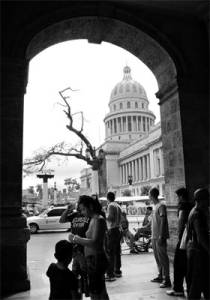
Whether they achieve their objectives or not, only time will tell. What is clear is that many young people, workers, professionals, technicians, homemakers and retirees who have spent their lives for this lamentable system of “state socialism” are unwilling to continue putting up with the deceit.
They’re demanding radical changes to the state-centric economic and social policies of the party/government.
These same people from below — on their own and without waiting for the readiness or approval of the established bureau-bourgeoisie — are carrying out various life-important economic, social, cultural and political initiatives outside of state institutions.
It is within those institutions where many are grabbing on, attempting to control everything possible in society while accusing their opponents complicity with the imperialist enemy.
Any initiatives from outside bureaucratic control are met with the slogan, “Either you are with us, or you are with the imperialist enemy.” For them, then, there are no more options.
One has to ask themself: Who have been the true accomplices of the imperialist enemy?
Have they been those who have shown through their policies that “socialism” — which has never existed — has been a social, economic and political disaster. Are they those who have succeeded in making most people not even want to hear the word “socialism”? Those who have made Latin Americans reject socialism as an approach to people bettering their lives and living more freely?
Are the true accomplices of the imperialist enemy those of us who want socializing and democratizing changes now, with less state and bureaucratic control over the economy and politics?

Alternatively, are they the supporters of counter-revolutionary immobilism, who are counting on foreign investment and private capitalism to save their state-centered bureaucratic wage-labor model of the neo-Stalinist cut, to later “try” to reintroduce the cycle of bourgeoisie expropriation by the “working class”?
Are the accomplices of the enemy the ones who have never set out to change production relations of capitalism?
Are they the ones who wish to deepen the revolution and change everything that resists it or are they those who in the name of change don’t want to change anything, so that everything remains the same, especially the same bureaucracy that has held political power for a half a century and has led the country to the current disaster?
Are they the ones who turn to various forms of violence and repression to combat those who peacefully advocate different ideas?
Likewise, the following will also have to be answered: Can the majority of those old, reactionary, conservative, stiff and accustomed brains, with their old, authoritarian, bureaucratic-centralism-educated ways of command and control change their mindsets, as is demanded by those at the heights of power when self-recognizing the incapacity of the centralized system?
Wouldn’t it be better to set aside those stuck in neo-Stalinism thought and instead empower the people, the younger generations, to democratically develop new forms of social, economic and political organization and new leaders demanded by the changing situation, instead of seeking a “cadre policy” aimed at ensuring the perpetuation of “everything that must be changed”?
I hope the party conference this January will help in finding answers to these questions, whether by action or omission.


2 RESPONSES TO “CUBA: COUNTER-REVOLUTION VS. SOCIALIST UTOPIA”
  1. Like all Marxists, comrade Pedro apparently believes that only state property is socialist, and that socialist property can only be that owned by the state. The fact that he calls for democratic running of state-owned enterprise by the workers does not alter the fact that he is, in a programmatic sense, a state monopoly socialist.
    The old Utopians made the programmatic error of abolishing private productive property rights immediately. Those entering their exemplary communes put everything into the communal pot, and this was going to show the world how communism could be exampled and built right now, without a multi-generation bridge to is elimination.
    The Marxists speak of socialism as a bridge to a society without private property, then force the abolition of private property onto society at the beginning of the bridge journey. It has never worked.
    Marxism makes the same programmatic error as the Utopians, by making everything productive common, state property, as did Cuba by 1968. Pedro Campos still cannot understand that workers can only achieve democratic self-management of the workplace by owning it directly. He clings to the fantasy that someday, somehow the workers could and would achieve workplace democracy under state monopoly ownership socialism.


    • THIS IS MY RESPONSE:

      Grady thinks that direct workers ownership of the workplace will bring socialism. If that ownership is capitalist – which it will be if the state hasn’t expropriated the capitalist bourgeoisie – then the workers will start off exploiting themselves and before long transform themselves into capitalists using the labour of workers imported from outside the workplace. This is anarchist, autonomist utopianism.

      But for a state to expropriate capitalism, it can’t be a bourgeois state – the bourgeoisie won’t expropriate itself. Individual bourgeois rivals – of course! But not the whole class. And to create a non-bourgeois non-capitalist state you need an anti-capitalist revolution that tears the means of production (land, factories, finance) out of the hands of the bourgeoisie, and takes them into its own hands defending them against the raging bourgeoisie/imperialism by force of arms.

      The problem of a non-capitalist state run by a reactionary privileged bureaucracy is one facing every workers (plus peasants) revolution. Revolutions can degenerate, and the harsher the pressure from imperialism, and the less well-developed the material preconditions for modern production, the easier this degeneration is. This was seen in the USSR in the 1920s in the losing battle fought by the revolutionary Left Opposition against the degenerating Stalin-led wing of the Communist Party. The defeat of the revolutionaries led to the political degeneration of the USSR and ultimately to its capitulation to imperialism in 1991. And made the successful anti-capitalist revolutions in Yugoslavia, Vietnam and China deformed from the start, since they took the degenerated Soviet Union as their model. No workers democracy – in fact, anything but workers democracy!

      Before the threat of imperialist restoration in China (the biggest threat) or Cuba (most important for Latin America and the Americas including the US) can be properly tackled, all this historical experience needs to be examined, understood and assimilated. Which means spreading and discussing in depth the issues and arguments in the 1920s when the revolutionary fire was still bright in the Soviet Union. Which means discussing the Left Opposition and most significantly the arguments and positions of its leader, Leon Trotsky, whose role in the October Revolution together with Lenin can be compared to the teamwork of Fidel and Che in Cuba, with the difference that Lenin and Trotsky were incomparably better versed in Marxism and more deeply rooted in working class revolutionary activity.

      Pedro passes over this completely. And this makes his well-meaning words a bit like foam on the waves. History and the workers revolutionary movement are the ocean and the Gulf Stream, speeches detached from these are liable to be flung in the air by a rock and swept away by the wind.

3 November 2011

Learning poems by heart - and censorship of "foreign"

A nice piece in the Guardian about the benefits of learning poems by heart at school.
http://www.guardian.co.uk/education/mortarboard/2011/nov/03/fielding-poetry-rime-of-raving-dotard
My comment was inexplicably deleted. Here it is anyway - followed by my follow-up comment...


One of the best things you can give the kids at school - all categories.
And the better your choice, the greater the treasure they carry with them through life.
If it's memorable, they'll memorize it - even if it's memorable only for your own enthusiasm or the blood and thunder Fagin/Frankenstein presentation. 
That's a teacher's view. As a kid, I remembered a lot - as pointers, not as whole poems. The mountain sheep are sweeter/But the valley sheep are fatter./We therefore deemed it meeter/To carry off the latter... Ours not to reason why/Ours but to do or die/Into the valley of death/Rode the six hundred... St Agnes Eve - Ah, bitter chill it was/The hare limped trembling through the frozen grass./Numb were the beadsman's fingers as he told/His beads. His beads he told, this patient holy man.... O Wild West Wind, thou breath of autumn's being...  If Winter comes, can Spring be far behind. 
Non-pointing wholes were the exception - Ozymandias (how not!), a couple of Wordsworth's things, Tyger, Jabberwock, and a fair few Donne Falling Stars. 
But later, learning languages and having runs to pace, I got into Chaucer - original Prologue some way in, and Latin, Catullus, Horace and my special favourite the invocation to Venus and Spring and Epicurus of De rerum natura.
Banging it in.
Benefits so great I even got my 8th grade immigrant kids in the Stockholm ghetto school to work through Vivamus mea Lesbia atque amemus in enough detail to get it by heart if they wanted to. (The Latinos helped with the first vocab runthrough).
Rhythm, word music, real life - all resonating inside as Wystan says. Ignore crabbed age and celebrate golden youth.
In der Jugend goldnen Schimmer... Unter den linden,/ an der heide/da unser zweie bette was,/da muket ir finden/schone beide/gebrochen bluomen unde gras./Vor dem walde in einem tal - /tandaradei! - /schone sanc diu nahtergal... 
And if you want to learn Swedish, try Fröding... 
Havet välte, stormen ven,
vågorna rullade asklikt grå.
"En man är vräkt över bord, kapten!"
"Jaså."
So much for God.
"Den dröm som ej aldrig besannats,
som dröm var den vacker att få.
För den som ur Eden förbannats,
är Eden en Eden ändå."
So much for the cynics.
Or Ferlin:
"Du har tappat ditt ord och din papperslapp, 
du barfota barn i livet.
Nu sitter du åter på handlarns trapp,
och gråter så övergivit.
Vad var det för ord, var det långt eller kort?
Var det väl eller illa skrivit?
Tänk efter nu förrn de föser dig bort,
du barfota barn i livet..."
So much for the Tories and Gradgrinds of this world.
Or Diktonius:
"Röd Eemili ramlade perklande raklång i snön..."
Or Almqvist:
"Men utur rike prästens ko 
var den söta mjölken.
Barnen fingo stå
vid modrens bål."
So much for White Terror and witch-hunters...
Or the shortest sweetest poem I know (Yugoslav folk):
Дај
Боже
да драги 
може!
Time to leave?
I will arise and go now,
and go to Inisfree,
and wear the bottoms of my trousers rolled...
And savage indignation there will no longer lacerate my breast.


[Follow-up:]
Since my comment above was deleted presumable cos some of the quotes were in foreign, I'd just like to say that most of my school learnings-by-heart were pointers not full poems. Full poems and long stretches came later when I needed to pace long runs and fill queuing with some meaning if I couldn't read or think. And a lot of the time they were in foreign.
Wystan's "resonance" is spot on. And so is the teaching power of making poems (or any resonant language artefact) your own.
That's it. As for the quotes etc you don't know what you missed.


23 September 2011

Dealing with dumping..

A nice question and answers in an agony aunt column in the Guardian
http://www.guardian.co.uk/lifeandstyle/2011/sep/22/private-lives-relationship-ended-upset
dealt with the end of a relationship. A modern one with no professions of love for instance, but still leaving the woman devastated when she felt dumped. 


My comment was:
You were spinning a cocoon, he perceived that you were erecting a cage. 
As for saying you love someone or not, words don't count. He probably thought he was being honest and that you wouldn't accuse him of betraying Love. You probably thought he expressed Love by his actions and the way he looked at you and held you.
My guess is that any neediness came from a deep desire for affirmation, and that this is a wish rooted in something missing in your emotionally formative years as a child. Think about this, because if it's even partially the case you want something from a partner (ANY partner) that you can't get in an adult relationship. Affirmation between two adults is different from that in the relationship between a parent (or equivalent) and a child.
And if you weren't affirmed (ie loved for what you were) as a child, you'll be screwed as an adult till you mourn your loss (no solid emotional ground to stand on). We need firm ground to stand on, not straws to clutch at.
On a cheerful note - the abyss we keep slipping back into is never bottomless - if we touch bottom (which we can do by "letting go" ie surrendering to our misery ie mourning the loss) then we can push off up again.
Cocoons and cages (or, in the case of a lot of men, harness, reins and whip) won't do the trick. The only constraints we thrive on, that we feel good and human within, are voluntary and reciprocal.
That'll do for now, I hope. 
(Maybe some other time I'll have an opportunity of developing the positive aspects of all this - they are many and strong. One to think/feel about is that deep down inside we're all the same, and have an emotional strength and resilience (capacity to spring back again) that keeps us going - and this would be impossible without great love and warmth. Our *own* inner warmth and love, deep within the heart of humanity.)

Faster than the speed of light...

An article in the Guardian this morning refers to experimental evidence that neutrinos may travel faster than light.
http://www.guardian.co.uk/science/2011/sep/22/faster-than-light-particles-neutrinos
This would be a revolutionary discovery if it's corroborated.
I made the following comment from a materialist dialectical perspective :


Time is just an accident of interacting material forces. So the direction of time just reflects the direction of interaction. Cause and effect is an even more fundamental axiom in our understanding of the world than the constancy of the speed of light. Meaning cause comes first and effect follows it. Without cause and effect not only would we be buggered, there wouldn't be any us to be buggered.
So indeterminacy and the rest of it is an arse-first way of saying we don't clearly understand it all yet.
So, whatever the relative speeds of photons and neutrinos, ie however rapidly they change their positions, they don't make time into a substantial phenomenon we can travel in. Things happen, including us. Because of the constancy of this, and because of our understanding as a reflection of it (ie back to front) we invented time as a measure of change. Just as we invented logic to tame the regularity in change.
Being (things and forces) is there. Thought (our inventions) helps us deal with it.
No Thought without Being. Plenty of Being without Thought.
I'll save Nothing and Becoming for another comment.

11 August 2011

The British riots - symptoms aren't causes

An article in the Guardian by Zoe Williams, who has her headed screwed on, discussed vigilanteism and its relation to a functional society.
http://www.guardian.co.uk/commentisfree/2011/aug/10/uk-riots-vigilantism-big-society
I made the following comment:

Zoe writes: "Big society might look like people on the streets with brooms or doner knives; but that's not what functional society looks like."
For a long time society has been very functional - for the bourgeoisie running a capitalist society for their own benefit and enjoying a monopoly of violence (army and police) and public judgement (ie condemnation, punishment and criminalization of their antagonists).
Now not even the bourgeoisie and its public representatives (damn near everyone in politics and the media) can run a functional society. "Those above can't rule, and those below can't be ruled".
Which leads to unofficial attack groups (ultra-right thugs, ultimately death squads) attacking the enemies of capitalism and the bourgeois state, and others who are singled out as scapegoats.
And since the rest of us need to mind our backs, we organize self-defence groups. An "invisible", organized and "orderly" class war breaks surface and becomes visible, 2-way organized (ie polarized) and "disorderly" from the rulers' perspective. And since organization, education about society and politics, creative and benevolent treatment has been cut out of the non-ruling body of those living and working (or jobless) in Britain, no one should be surprised when the social eruptions are disorganized, ignorant, anti-social, apolitical, destructive and malevolent. It happens in the slums of the US (LA) and France (Paris) and now (once more) Britain.
Given all this we should note that given the degree of damage to property there has been very very little damage to person, and given the number of the rioters the state response has been disproportionate, vindictive and divisive, to say the least. A typical image from the riots has been of a half-a-dozen heavily armoured, anonymous (super-hoodied), armed police, with leash-tugging dogs and armoured cars in the background standing over a single unarmed lad who's about to be carted off and done over (if not physically, then civically).
The howls of rage at the symptoms (sometimes ugly symptoms) are hypocritical and cynical given the wilful neglect of the causes underlying these symptoms.
And the causes are inseparable from this bourgeois capitalist society, and will only become more deeply rooted and virulent as this society becomes less and less functional even on its own terms.
Temporary alleviation was achieved with the New Deal and the Welfare State in the 30s and 40s. However, this only occurred in powerful countries after their bourgeoisies were threatened with extinction by colonial independence and revolution - oh, and after a world war that ended with ultra-imperialist Churchill being unceremoniously dumped by the workers who had fought his imperialist war for him.
So now New Deal or Welfare State for a while yet, just more of the same gouging out of living flesh. And more and more panicky squealing and scapegoating from defenders of the state as quo (with no quid).

9 August 2011

The riots in Britain - London, Bristol, Birmingham and Liverpool so far

I made the following comment on the live coverage of the riots in the Guardian (http://www.guardian.co.uk/uk/blog/2011/aug/09/london-riots-violence-looting-live)


Very briefly - it's not the government, it's the class they represent. The bourgeoisie has a monopoly of everything public in Britain Europe and most of the world today, and they're using this public authority to smash all public enterprise, goods, services and amenities they can. To put the profits from this into their own pockets (that's what profit is - private money after productive capital investment and unproductive military and ideological expenditure are taken care of). They're looting the general public (us) using the monopoly of public violence (military, police) their system gives them, not us.
Now the most reviled and criminalized and impoverished section of the general public - immigrant, slumdwelling working class lads are reacting in the way they have seen the ruling class acting towards reviled, impoverished and criminalized foreign countries - burning and looting. But they show none of the indiscriminate ruthlessness of the bourgeoisie on the rampage in the colonial wars of Britain and France, or the imperialist wars of the US.
They are a barometer showing the way the rest of us are feeling. They can react spontaneously this way because they aren't tied down by property debt, car and other loans, or a job to lose. And have the energy of youth. The rest of us don't challenge state (class) violence so lightly.
But when we do, it will need more than thousands of police to curb us. There are so many of us that we'll be kettling them, and occupying their lives the way they have been occupying ours.
And we'll be organized, and have a clear idea about what we need to do to get them off our backs for good, and tear public wealth out of their greedy, gory hands.

6 August 2011

Cochlea implants and discrimination against the deaf

An article in the Guardian:
http://www.guardian.co.uk/commentisfree/2011/aug/05/deaf-people-cochlear-implants
took up the arrogant and authoritarian attitudes of hearing experts in relation to deaf people and cochlea implants. A lot of the commentators piled in on the side of those vilifying the deaf. So I added this comment:


TimSkellet's early comment is excellent - the historical perspective is absolutely necessary here. Since sign language is a native language like any spoken language (lexicon, syntax, semantics, brain location) this whole business is the same as the ignorant and vicious attacks common in relation to bilingualism or language diversity.
The audiologists campaigning against sign language users are no different from race biologists or ethnic cleansers - or the academic thugs attacking minority languages or languages on the brink of extinction.
These implants are very expensive. The people working with implants have a vested interest in promoting the intervention. They are like Microsoft Windows propagandists in IT.
Look - as hero of the intolerant and bigoted Maggie Thatcher used to say and probably still does - minorities can chew gum and walk at the same time. If I know two languages well, say Finnish or Welsh and English, then I use them both as I choose, as I see fit, according to my whim. It's my right, just as it's my right to go into a shop and spend my money any way I like. It's none of your damn business to tell me what to buy or how to use what I buy. Western civilization. Right of ownership. What's mine is mine to use and abuse. And my language is more important to me than any consumer crap. These audiologists (and the other geocentrics I've mentioned) would scream blue murder and call in the cops and the court of human rights if they were forced, or even just pressured into using their school French instead of their native language (presumably English). Well, sign language is the English of deaf people, and oralism or cochlea speak is their school French.
And we all know that women are imperfect men and blacks are imperfect whites, so let's operate them too to assimilate them and lift them out of their miserable victimized status.
What a shitty society where imbeciles in a position of authority and status insist on either/or instead of both/and.

23 July 2011

The Oslo bombing and massacre - right-wing terror


On a discussion list a Swedish contributor was quite right about the blindness of the established bourgeois/imperialist rulers to the right-wing threat. I added a few reflections:

First a couple of general remarks beside the main point:

1) Swedish TV has been broadcasting Norwegian TV more or less non-stop since yesterday afternoon, in Norwegian, with no subtitles or translation, just as is. It's astounding how easy it is to follow. Easier than local comments from football managers or players around Sweden. Few linguistic or cultural barriers to greater political unity in the Nordic countries (the slightly greater initial linguistic problems with Denmark etc would only require a little extra good will).

2) The characteristic informal and democratic tone and approach between people in the Nordic countries has been very evident in the main. Also the lack of hysteria and the thoughtfulness in the responses even of those injured or witnessing the destruction and murder.

3) More than 80 youngsters slaughtered in a country with a small population like Norway will have a huge personal and social impact. That's a lot of families and friends and communities with a gaping emotional hole suddenly ripped open. And a whole youth movement traumatized. 500 young Social Democrats were at the camp, and almost a fifth of them were wiped out.

And now some political thoughts:

1) The immediate reactions, although guarded, were full of the established "security" (ie insecurity) perspective. Parallels to the Twin Towers, the naming of Al-Quaida, the naming of a fundamentalist cleric with asylum in Norway, discussions of police and secret police and political security readiness - the lot.

2) They all chimed in "on message". Swedish Foreign Minister Carl Bildt. Australia. The EU. Obama, a complete reptile, obviously didn't give a fuck about the victims, but preached the need for increased cooperation between (imperialist) secret services and greater political unity (ie "toe the line").

3) The damage was huge - the street and district looked as if they'd been hit by an Israeli or US bomb or two. But more like Oklahoma City than Gaza or Fallujah.

4) The before and after contrasts were very telling. While the assumption was a fundamentalist Islam cell, the talk was all strategic, international, "security" and politics. When it was discovered it was a right-wing reactionary all this vanished and the personal aspects took over. Less "atrocity" and more "tragedy". No more stiff upper lip spirit of the blitz, but let the tears roll. In other words it was sentimentalized, personalized and trivialized. The insecurity experts were allowed to slouch off home to lick their wounds, so to say.

5) The arrested suspect (clearly responsible) is a reactionary Freemason fundamentalist Christian militia guy with a number of powerful guns (legal) who ran a small farm so he could buy 3 tons of bomb-grade fertilizer and assemble his car bomb. Blond, tall, business education. Wore police gear and looked like a cop so he had no trouble calling the youngsters at the party camp to a meeting to talk about the bombings in Oslo and then shoot them like sheep in a pen. So of course everyone started baying for Freemason blood, for total control and clamp down on the militia-like gun groups (legal), a ban on right wing Christian groups and propaganda, business education, and reactionaries. Right...

6) The full crocodile cohort was rolled out - archbishops, royalty, the more unctuous anchor guys.

7) The political implications of the party attacked (the (very unworker, very pro-bourgeois) Labour Party) were toned down immediately. Socialism and the welfare state as obvious targets for reaction were never mentioned.

8) It's easy to hate a swarthy raghead Ay-rab, but not so easy to hate a reactionary blond beast in evening dress swathed in posh orders.

9) The massive scale of the destruction and carnage (in peacetime Nordic circumstances, not Gaza, Fallujah or Kandahar) has made it difficult to find a single victim to tether the personal sentimental response to.

10) Total absence of discussion of the need for a mass, class-based mobilization aiming for secure housing, health, employment, and living conditions as the only real, deep, long-term solution to this kind of problem.

11) On the bright side, no polarizing hero-worship and demon-hatred as at the Twin Towers - no beatified fire-fighters or vilified Saudi allies (oops, I meant middle-eastern Muslims). No glazed-eyed Bush panic. Dignity and restraint. Unlikely to be any ring of steel around Gardemoen airport the way Blair surrounded Heath Row with tanks.

12) Yet again the futility of individual terror as a political weapon has been revealed. The victims had no power over policy, their deaths will harden opinion against the perpetrator(s) and encourage yet more repression and spying on citizens in their everyday lives. In this case however, the bomber and assassin may actually have furthered his cause - any repressive measures taken will almost certainly impact his enemies more than his political friends. Islam will be accused of creating an atmosphere of terror that encourages this "madman" (he will certainly be written off as a lunatic in a further trivialization of the affair) to act the way he did. So perhaps it's not the futility of individual terrorism that has been revealed, but the way it can be exploited if used cunningly and indirectly. The strategy of a successful "agent provocateur" (as used in India in Bombay for instance, regardless of whether the provocateurs are Pakistani or Indian government agents).


These are my immediate reactions.